




- Part Geometry and Cost-Saving Results
- Quick DFM Guidelines for Small Powder Metal Components
- Material Selection Impacts DFM for Powder Metal Components
- Design Optimization Examples & Case Studies
- Our DFM Consultation Process
- The ROI & Logistics of Material Efficiency and Repeatable Quality
- DFM & Engineering Support for Powder Metallurgy Design
Part Geometry and
Cost-Saving Results
When a miniature gear requires a 0.3 mm wall or a medical component includes undercuts, machining costs rise quickly. When these designs, or others, move to powder metallurgy production, engineers often discover that the design rules are very different from CNC machining, and that powder metallurgy significantly reduces cost while producing high quality, high volume, durable components.
To achieve the highest performance at the lowest total cost of ownership, your component should be designed specifically for the Powder Metallurgy (PM) process rather than adapted from traditional machining. Certain design geometries are critical for structural integrity and tooling longevity. We have in-depth, highly technical resources you can download to learn about the specific geometric guidelines to follow (such as wall thickness, radii and fillets, avoiding undercuts, and more) as well as discover PM’s cost-effective advantages for high-volume production.
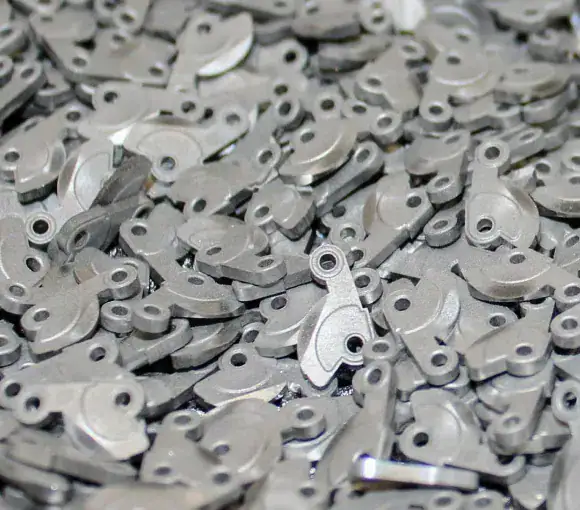

An Engineer’s Guide to Design Considerations for Powder Metallurgy
Learn about part features, tolerances, and guidelines for designing powder metal components. Includes diagrams.

The Manufacturer’s Playbook for Small Parts: Cost Savings of Powder Metallurgy vs. Machining
Learn what makes PM a highly effective cost-saving process and how OEMs who made the switch have benefitted.
Quick DFM Guidelines for Small Powder Metal Components
Our quick reference guide below offers some key information on design guidelines at a glance. For more comprehensive information and details, check out the full guide which provides more essential information and considerations on many more design features.
-
Maintain Uniform Walls
For many small PM components, wall thicknesses in the .06 – .11 in. range provides stable compaction and sintering. Variations over a 3:1 ratio between thick and thin sections create density gradients that weaken the part.
-
Design Along Press Direction
- Place key features parallel to the compaction axis
- Use straight or tapered walls (1-3° draft) for safe ejection
- Avoid cross holes and perpendicular threads
-
Limit Fine Features
Do not design features that powder cannot physically fill. Typical minimum feature sizes include:
- Teeth: .019 in. (0.5mm) from AGMA class 7 to AGMA class 10 in some cases
- Holes/Slots: .0394 in. (1mm) minimum
- Edge radii: .0079 in. (0.2mm) minimum (prevents powder bridging)
-
Specify Achievable Tolerances
As-sintered PM tolerances typically range from ±.003 to ±.004 in., depending on geometry and tooling. We routinely hold ±.0005 in. on crucial dimensions using precision tooling, but specify tight tolerances only where functionally necessary to avoid secondary sizing costs.
-
Plan for Shrinkage
Parts shrink 0.5-2% during sintering. We compensate for this in the tooling, but complex geometries may shrink unevenly.
Material Selection Impacts DFM for Powder Metal Components
Our engineers review material choice early in the design phase:
Stainless Steel
Nickel Steel
Copper-Infiltrated
Custom Blends

Stainless Steel
Stainless Steel
Delivers corrosion resistance for medical and marine use. Demands careful atmosphere control and slightly larger tolerances.


Nickel Steel
Nickel Steel
Yields high strength for automotive gears. Excellent compressibility enables complex geometries.

Copper-Infiltrated
Copper-Infiltrated
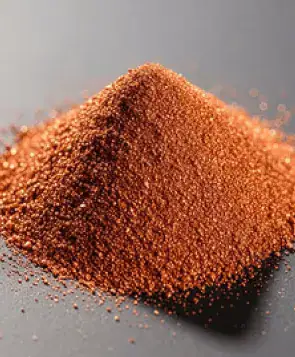
Copper fills pore spaces during sintering, improving strength and machinability for high-load applications.


Custom Blends
Custom Blends
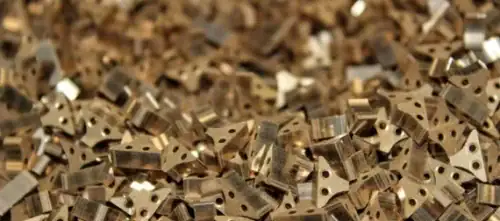
Application-specific formulations optimize wear resistance, magnetic properties, and more. Read our case study of how we combined tungsten and brass to achieve the desired weight and shape of an automotive counterweight.
Material Performance & Specifications: Density vs. Mechanical Properties
Engineers need to know if their specified material can handle the load required in their application. In powder metallurgy, density equals strength. Unlike cast or wrought metals, PM parts have controlled porosity. By adjusting the density (typically between 6.4 and 7.2 g/cm³ for steel, for example), we can tailor the mechanical properties to your specific application.
| Material | Typical Density (g/cm³) | Tensile Strength (PSI) | Key Characteristics & Applications |
|---|---|---|---|
| Iron (Pure/Low Carbon) | 6.2 – 7.0 | 20,000 – 35,000 | Soft magnetic properties; low-stress spacers and brackets. |
| Nickel Steel (Iron-Nickel) | 6.7 – 7.2 | 45,000 – 85,000 | High strength and wear resistance; ideal for structural gears. |
| Stainless Steel (300/400) | 6.4 – 7.0 | 60,000 – 95,000 | Excellent corrosion resistance; common in medical devices and automotive parts. |
| Copper | 7.5 – 8.3 | 20,000 – 30,000 | High thermal and electrical conductivity; used in heat sinks, bushings, and more. |
| Brass | 7.2 – 8.2 | 25,000 – 40,000 | Good corrosion resistance and aesthetic appeal; used in hardware and small gears. |
| Nickel | 7.5 – 8.5 | 40,000 – 60,000 | Exceptional resistance to oxidation and extreme temperatures. |
*The figures in this table are typical values and not absolutes.
While pure iron and copper offer specific conductive or magnetic properties, nickel steels and stainless steels are the industry standards for mechanical components where durability is the priority. When choosing between brass and stainless steel for corrosion resistance, note that while brass is malleable and ductile, stainless steel often offers a higher strength-to-weight ratio for miniature components. Visit our Powder Metal Materials Selection Guide for more in-depth information about powder metals, considerations, and more.
Not sure which material would meet your load requirements? Use any of our Torque & Gear Calculators to validate your design’s performance.
Design Optimization Examples & Case Studies
-
1. Consolidation & Cost Reduction (Medical Device)
1. Consolidation & Cost Reduction (Medical Device)
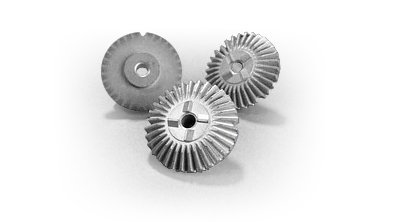
- Application: Metal Bevel Gear for a disposable medical instrument.
- Optimization: The design was transitioned to 304 stainless steel using a consolidated design approach. By utilizing PM’s ability to create complex shapes in a single step, Allied Sinterings eliminated the need for multi-part assemblies or extensive machining.
Result: Achieved a 45% reduction in production costs while maintaining the high performance and sterilization standards required for medical patient care.

-
2. Noise Reduction & Precision (Lighting Systems for Appliances)
2. Noise Reduction & Precision (Lighting Systems for Appliances)
- Application: A single-stage planetary gearset consisting of five components (input flange, output flange, planet gear, sun gear, and ring gear).
- Optimization: By leveraging advanced process monitoring and state-of-the-art PM equipment, the components were manufactured with extremely tight tolerances.
Result: The precision of the gear mesh resulted in virtually noiseless operation, which was a critical requirement for high-end lighting controls.
-
3. Extreme Tolerance Control (Electric Vehicles)
3. Extreme Tolerance Control (Electric Vehicles)
- Application: Pinion gears for electric vehicle (EV) components.
- Optimization: The inner diameter (ID) tolerances were optimized to be significantly tighter than industry standards—specifically 7/10ths of the typical tolerance usually required for such parts.
Result: This high-precision molding allowed the parts to meet the rigorous performance and assembly standards of the automotive EV sector without the high cost of secondary grinding or specialized machining.
-
4. Material Substitution & Safety (Automotive)
4. Material Substitution & Safety (Automotive)
- Application: Needle indicator counterweights for analog dashboards.
- Optimization: The original design used lead, which posed environmental and safety risks. Allied Sinterings optimized the material to a custom tungsten and brass powdered metal blend.
Result: The new material provided the exact density and functionality required for the counterweight while eliminating hazardous lead from the manufacturing process and the final product.
-
5. Net-Shape Manufacturing (General Efficiency)
5. Net-Shape Manufacturing (General Efficiency)
- Optimization Strategy: Design for “Near Net-Shape” to utilize 99.8% of raw materials.
Result: Unlike traditional CNC machining which can generate up to 70% scrap material, these optimizations ensure that almost every gram of powder ends up in the finished part, significantly lowering the total cost of ownership for procurement teams.


Our DFM Consultation Process
When you submit a Request for Quote, Allied Sinterings reviews your CAD or other files specifically for PM manufacturability:
- Feasibility Assessment: We evaluate geometry against the mechanical constraints of powder metallurgy tooling and compaction.
- Optimization Recommendations: We don’t just reject complex files. We suggest precise tweaks such as shifting a hole or thickening a wall to make it press-ready while preserving its function.
- Tooling Strategy: For complex components, we determine optimal tooling approaches (multi-level compaction, core rods) to balance tooling complexity, part tolerances, and production cost.
Once our design for manufacturability analysis is finished, we work with you to optimize your part’s drawing.

The ROI & Logistics of Material
Efficiency and Repeatable Quality

Material Utilization: Powder Metallurgy vs. Machining
Traditional machining can waste up to 70% of raw material in the form of chips and scrap. Allied Sinterings’ powder metallurgy process utilizes 97% to nearly 100% of the raw material. This “green” efficiency directly translates to lower part costs, especially when working with expensive alloys.

Quality & Risk Mitigation
- ISO 9001:2015 Certified: Our quality management system ensures every batch meets your precise tolerances.
- ISO 13485 Compliance: We have tailored quality controls for medical device components.
- Repeatability: Once a tool is qualified, the PM process produces thousands of identical parts with minimal dimensional drift.
- AGMA quality guaranteed

Timeline & Production
- New Tooling: 6 to 8 weeks (depending on complexity).
- Standard Production Lead Time: 4 weeks for repeat orders.
- Economic Order Quantity (EOQ): PM is most cost-effective for annual volumes of 10,000+ pieces, though we provide prototypes for smaller pilot runs.
DFM & Engineering Support for Powder Metallurgy Design
Successful design for manufacturability requires recognizing the physical differences between pressing powder metal and cutting solid stock. Our team brings over six decades of small-component expertise to every project, identifying manufacturing constraints during the design phase.
Whether you are designing miniature gears for motion control systems or precision structural components for medical devices, early DFM collaboration gets your parts to production faster.
Have a component design requiring review? Request a quote with your CAD or other files, or contact our engineering team to discuss your designs. We deliver feasibility assessments within 48 hours – preventing costly tooling changes and accelerating your transition from prototype to production.
